


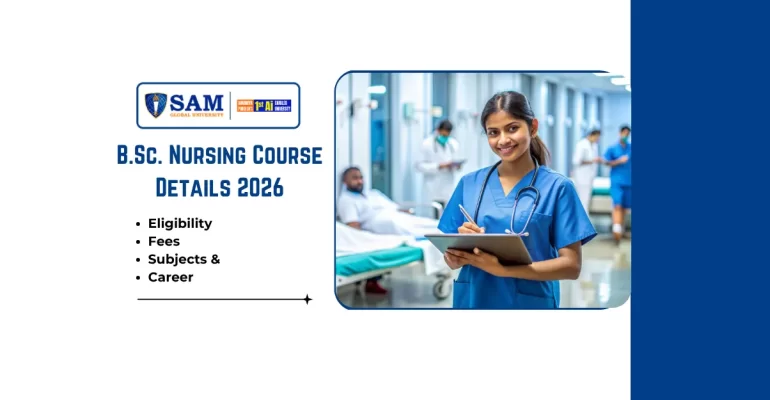
B.Sc. Nursing Course Details: Eligibility, Fees, Subjects, Syllabus, Entrance Exams, Career & Best Private Colleges in Bhopal
August 22, 2026 2026-08-25 5:49B.Sc. Nursing Course Details: Eligibility, Fees, Subjects, Syllabus, Entrance Exams, Career & Best Private Colleges in Bhopal
B.Sc. Nursing Course Details: Eligibility, Fees, Subjects, Syllabus, Entrance Exams, Career & Best Private Colleges in Bhopal
B.Sc. Nursing is one of the most popular undergraduate healthcare courses for students who want to build a professional career in nursing and patient care. The course combines classroom learning with practical and clinical training, helping students develop the knowledge and skills required to work in hospitals, clinics, community healthcare and other healthcare settings.
For students planning B.Sc. Nursing admission after 12th, important factors include eligibility, entrance exams, course duration, subjects, fees, career opportunities and college facilities.
This guide explains the B.Sc. Nursing course in simple language, with a special focus on admission and private nursing colleges in Bhopal.
What is B.Sc. Nursing?
B.Sc. Nursing (Bachelor of Science in Nursing) is an undergraduate professional degree that focuses on nursing science, patient care, healthcare management, disease prevention and clinical practice.
During the course, students learn subjects related to anatomy, physiology, pharmacology, medical-surgical nursing, community health nursing, mental health nursing, child health nursing and other areas of healthcare.
The programme also includes practical and clinical exposure so students can understand how nursing knowledge is applied in real healthcare situations.
According to the Indian Nursing Council (INC), the basic B.Sc. Nursing eligibility includes 10+2 with Science (PCB) and English, with 45% aggregate marks from a recognized board. The minimum age is 17 years as of December 31 of the admission year.
B.Sc. Nursing Course Highlights
| Particular | Details |
|---|---|
| Course Name | B.Sc. Nursing |
| Degree Level | Undergraduate |
| Course Duration | 4 Years |
| Eligibility | 10+2 with PCB & English |
| Main Subjects | Physics, Chemistry, Biology in 12th |
| Minimum Marks | Generally 45% in PCB & English as per INC norms |
| Admission | Entrance exam / merit / counselling, depending on state & institution |
| Course Type | Professional Healthcare Course |
| Practical Training | Yes |
| Career Areas | Hospitals, Clinics, Community Health, Nursing Homes, Healthcare Organisations |
Note: Admission requirements can vary according to the state, university and admission authority. Students should always check the latest admission notification before applying.
B.Sc. Nursing Eligibility Criteria
Students interested in B.Sc. Nursing generally need to fulfil the following requirements:
1. Educational Qualification
Candidates should have passed 10+2 or equivalent examination with Science subjects, particularly:
- Physics
- Chemistry
- Biology
- English
The Indian Nursing Council specifies 45% aggregate marks for B.Sc. Nursing eligibility.
2. Age Limit
The minimum age for admission is 17 years as on December 31 of the admission year.
3. Medical Fitness
Candidates are required to be medically fit for admission to the programme.
4. State-Specific Eligibility
Some states may prescribe additional eligibility conditions, reservation rules or entrance examinations.
For example, the MP PNST is an important entrance route for B.Sc. Nursing admissions in Madhya Pradesh. The MP ESB's 2026 schedule lists PNST 2026 as an entrance test, with applications from June 9 to June 23 and the examination scheduled from July 10 to July 13, 2026.
B.Sc. Nursing Admission 2026
The admission process depends on the state and college.
Generally, students can expect these steps:
Step 1: Check eligibility
↓
Step 2: Apply for the relevant entrance exam or college admission
↓
Step 3: Appear for the entrance examination, if applicable
↓
Step 4: Check result/rank
↓
Step 5: Participate in counselling or college-level admission
↓
Step 6: Document verification
↓
Step 7: Pay admission/tuition fees
↓
Step 8: Begin the B.Sc. Nursing programme
Students planning admission in Madhya Pradesh should particularly check the latest MP PNST notification and counselling rules.
B.Sc. Nursing Entrance Exams
There is no single entrance examination that applies uniformly to every B.Sc. Nursing college in India. Admission routes can differ between states, universities and institutions.
Some common admission routes include:
MP PNST
For students targeting B.Sc. Nursing admissions in Madhya Pradesh, the Pre-Nursing Selection Test (PNST) conducted by Madhya Pradesh Employees Selection Board is an important state-level entrance examination.
The MP ESB currently lists PNST 2026 under its entrance tests.
Other Nursing Entrance Exams
Depending on the state or institution, candidates may also encounter:
- State-level nursing entrance examinations
- University-level entrance examinations
- Merit-based admission
- Counselling-based admission
Therefore, students should check the admission notification of the particular college before deciding whether an entrance examination is required.
B.Sc. Nursing Fees
The B.Sc. Nursing fees can vary considerably depending on the college, university, facilities, hostel and other services provided.
Typical fee components may include:
- Tuition fee
- Examination fee
- Registration fee
- Laboratory fee
- Clinical training charges
- Library fee
- Hostel fee, if applicable
- Uniform and other institutional charges
Instead of looking only at tuition fees, students should compare the total cost of education and the facilities offered by the college.
What affects B.Sc. Nursing fees?
The fees may depend on:
- Type of institution
- Location of the college
- University structure
- Clinical training facilities
- Hostel and campus facilities
- Laboratory infrastructure
- Other academic and administrative charges
Important: Always verify the current fee structure directly from the college before admission because fees can change from one academic session to another.
B.Sc. Nursing Subjects
B.Sc. Nursing covers both theoretical and practical aspects of nursing.
Some important subjects include:
First-Year / Foundation Subjects
- Anatomy
- Physiology
- Sociology
- Psychology
- Biochemistry
- Nutrition
- Nursing Foundation
- Communicative English
For example, a B.Sc. Nursing examination timetable published by SAM Global University includes Applied Anatomy & Applied Physiology, Applied Sociology & Applied Psychology and Communicative English among first-semester subjects.
Other Major Subjects
As students progress through the programme, they study areas such as:
- Medical-Surgical Nursing
- Pharmacology
- Pathology
- Microbiology
- Child Health Nursing
- Mental Health Nursing
- Community Health Nursing
- Maternal Health Nursing
- Nursing Research
- Nursing Management
- Nursing Informatics
The exact semester-wise structure can vary according to the applicable curriculum and university.
B.Sc. Nursing Syllabus
The B.Sc. Nursing syllabus is designed to develop both academic understanding and practical nursing skills.
The curriculum generally covers four broad areas:
1. Basic Medical Sciences
Students learn about the human body and its functions through subjects such as:
- Anatomy
- Physiology
- Biochemistry
- Microbiology
- Psychology
- Sociology
2. Nursing Sciences
This area focuses on actual nursing care and includes:
- Nursing Foundation
- Medical-Surgical Nursing
- Child Health Nursing
- Mental Health Nursing
- Community Health Nursing
- Maternal Health Nursing
3. Professional Skills
Students learn:
- Patient assessment
- Vital-sign monitoring
- Infection prevention
- Patient communication
- Medication-related procedures
- Emergency care
- Documentation
- Patient education
4. Research and Management
Advanced areas may include:
- Nursing Research
- Statistics
- Nursing Management
- Leadership
- Health/Nursing Informatics
- Evidence-based practice
The MP ESB's 2026 nursing-related curriculum includes areas such as Nursing Foundation, health/nursing informatics, patient safety, clinical decision-making and evidence-based healthcare practice.
Where Can B.Sc. Nursing Graduates Work?
B.Sc. Nursing can open career opportunities in different areas of healthcare.
Common Job Roles
After completing the degree, graduates can explore roles such as:
- Staff Nurse
- Registered Nurse
- Clinical Nurse
- Community Health Nurse
- ICU Nurse
- Emergency Nurse
- Pediatric Nurse
- Mental Health Nurse
- Nursing Supervisor
- Home Healthcare Nurse
- Public Health Nurse
Career opportunities depend on the candidate's qualification, registration, experience, specialization and the requirements of the employer.
Career Opportunities After B.Sc. Nursing
One of the biggest differences between B.Sc. Nursing and many conventional undergraduate courses is the importance of practical and clinical training.
Students get opportunities to understand:
- Patient assessment
- Basic nursing procedures
- Infection control
- Ward management
- Emergency care
- Patient communication
- Clinical documentation
- Healthcare teamwork
Practical exposure helps students connect classroom concepts with real-world healthcare situations.
When selecting a college, students should therefore look beyond classrooms and check the laboratories, clinical exposure, faculty, hospital training arrangements and practical learning opportunities.
Where Can B.Sc. Nursing Graduates Work?
B.Sc. Nursing graduates can find opportunities across different healthcare settings, including:
Hospitals
Government and private hospitals employ nurses across departments such as:
- ICU
- Emergency
- Operation Theatre
- Medical wards
- Surgical wards
- Pediatrics
- Obstetrics and Gynecology
Community Healthcare
Nurses can also work in:
- Community health centres
- Primary healthcare settings
- Public health programmes
- NGOs
- Health awareness programmes
Nursing Homes & Clinics
Private healthcare facilities also require trained nursing professionals for patient care and clinical support.
Higher Education
After completing B.Sc. Nursing, students can also consider postgraduate education such as M.Sc. Nursing or other relevant advanced programmes, subject to eligibility requirements.
Government vs Private B.Sc. Nursing College
Students often have to choose between government and private nursing colleges.
| Factor | Government College | Private College |
|---|---|---|
| Fees | Usually lower | Can be comparatively higher |
| Admission | Often competitive | Depends on institution |
| Infrastructure | Varies | Often varies by institution |
| Clinical Exposure | Depends on available facilities | Depends on hospital tie-ups/training |
| Hostel | Depends on college | Often available in many institutions |
| Admission Process | Usually centralized/state process | May include university/college process |
The right choice depends on fees, recognition, faculty, clinical exposure, infrastructure, location and career support rather than simply choosing a college based on its category.
Best Private B.Sc. Nursing Colleges in Bhopal
Bhopal has several institutions offering nursing and healthcare education. While comparing colleges, students should check:
- University affiliation
- Applicable nursing council recognition/suitability
- Faculty
- Nursing laboratories
- Clinical training
- Hospital exposure
- Hostel facilities
- Library
- Student support
- Placement/career guidance
- Overall fee structure
The Indian Nursing Council publishes information on nursing institutions found suitable for the relevant academic years, making recognition/suitability an important factor to verify before admission.
SAM Global University, Bhopal
SAM Global University offers B.Sc. Nursing under its Faculty of Nursing. The university's published academic-programme document lists B.Sc. Nursing with an approved intake of 50 seats.
Students considering the programme should evaluate the university based on its nursing infrastructure, academic environment, practical training opportunities and current admission requirements.
How to Choose the Best B.Sc. Nursing College in Bhopal?
Before taking admission, don't select a college only because of advertisements or low fees.
Consider these points:
1. Check Recognition
Make sure the nursing programme and institution meet the applicable regulatory and university requirements.
2. Compare Clinical Exposure
Nursing is a practical profession. Clinical exposure is therefore extremely important.
3. Visit Nursing Labs
Check whether the college has adequate facilities for practical learning.
4. Check Faculty
Experienced and qualified faculty can make a major difference in your learning.
5. Compare Total Fees
Ask for a complete fee structure instead of looking only at tuition fees.
6. Check Hostel Facilities
Students coming from outside Bhopal should check hostel, food, safety and other student facilities.
7. Ask About Career Support
Find out whether the institution provides career guidance, internships, clinical exposure or placement support.
Is B.Sc. Nursing a Good Career Option After 12th?
Yes, B.Sc. Nursing can be a suitable career option for students interested in healthcare, patient care and medical sciences.
The profession requires responsibility, patience, communication skills and the ability to work in demanding healthcare environments.
Students should choose nursing because they are genuinely interested in healthcare—not simply because it is considered a high-demand course.
Skills Needed for a Successful Nursing Career
Academic knowledge alone is not enough for a nursing career.
Students should develop:
- Communication skills
- Patient-care skills
- Observation skills
- Teamwork
- Time management
- Emotional maturity
- Emergency response skills
- Basic technology skills
- Problem-solving ability
- Professional ethics
These skills become increasingly important during clinical training and professional practice.
B.Sc. Nursing vs GNM
Students sometimes get confused between B.Sc. Nursing and GNM.
| Feature | B.Sc. Nursing | GNM |
|---|---|---|
| Level | Undergraduate Degree | Diploma-level nursing programme |
| Duration | Generally 4 years | Generally shorter than B.Sc. Nursing |
| Academic Depth | More comprehensive degree-level study | Focuses on general nursing & midwifery |
| Higher Studies | M.Sc. Nursing and other options | Can pursue further education subject to eligibility |
| Career Scope | Broad professional opportunities | Nursing and related healthcare roles |
If you want a degree-level nursing qualification after 12th, B.Sc. Nursing can be a strong option to consider.
Documents Required for B.Sc. Nursing Admission
The exact list may vary by college, but students are commonly asked to provide:
- Class 10 marksheet
- Class 12 marksheet
- Class 10 certificate
- Transfer Certificate
- Migration Certificate, if applicable
- Entrance exam scorecard, if applicable
- ID proof
- Passport-size photographs
- Category certificate, if applicable
- Domicile certificate, if required
- Medical fitness certificate
Keep original documents as well as photocopies ready for verification
Frequently Asked Questions About B.Sc. Nursing
1. What is B.Sc. Nursing?
B.Sc. Nursing is a professional undergraduate degree focused on nursing science, patient care, healthcare and clinical practice.
2. How many years is B.Sc. Nursing?
B.Sc. Nursing is generally a 4-year undergraduate programme.
3. What is the eligibility for B.Sc. Nursing?
Generally, candidates need 10+2 with Science subjects including Physics, Chemistry, Biology and English. INC specifies 45% aggregate marks for the basic B.Sc. Nursing eligibility criteria.
4. Is PCB compulsory for B.Sc. Nursing?
For the standard B.Sc. Nursing eligibility prescribed by INC, candidates should have Science with PCB and English.
5. Is an entrance exam required for B.Sc. Nursing?
It depends on the state, university and college. In Madhya Pradesh, PNST is an important entrance route for B.Sc. Nursing admissions.
6. What is MP PNST?
MP PNST stands for Pre-Nursing Selection Test, conducted by the Madhya Pradesh Employees Selection Board for nursing admissions in the state.
7. What are the main subjects in B.Sc. Nursing?
Major subjects include Anatomy, Physiology, Nursing Foundation, Medical-Surgical Nursing, Pharmacology, Community Health Nursing, Child Health Nursing, Mental Health Nursing and Maternal Health Nursing.
8. What is the scope after B.Sc. Nursing?
Graduates can explore careers in hospitals, clinics, community healthcare, nursing homes, public health and other healthcare organisations.
9. Can I pursue higher studies after B.Sc. Nursing?
Yes. Eligible graduates can pursue postgraduate programmes such as M.Sc. Nursing and other relevant advanced studies.
10. What should I check before choosing a private nursing college?
Check recognition/suitability, university status, faculty, laboratories, clinical exposure, hospital training, hostel, fees and career support.
11. Is B.Sc. Nursing better than GNM?
Both are different nursing programmes. B.Sc. Nursing is a degree-level programme and may provide a broader academic pathway, while GNM is a separate nursing qualification. Your choice should depend on your career goals and eligibility.
12. Is B.Sc. Nursing a good course after 12th Science?
For students interested in healthcare and patient care, B.Sc. Nursing can be a good professional option. However, students should understand the academic, practical and professional responsibilities involved before choosing the course.
Final Words
B.Sc. Nursing is more than just a healthcare degree. It prepares students for a profession that combines medical knowledge, practical skills, patient care and responsibility.
If you are planning B.Sc. Nursing admission in Bhopal, compare colleges carefully on recognition, faculty, practical training, clinical exposure, infrastructure, fees and student support.
For Madhya Pradesh students, keeping track of MP PNST notifications, results and counselling updates is especially important because the admission process can be linked to the state-level entrance system.
Get Free Career Counselling
Related Posts




Search
Categories
- 10th 12th Result (76)
- 12th Boards Preparation Series (95)
- After 12th Careers (158)
- Agriculture (13)
- AI (17)
- B. Tech CS (AI) (5)
- B. Tech CS (DS) (5)
- B.J.M.C (2)
- B.Sc Forensic Science (1)
- Bachelor of Engineering (12)
- BAMS (19)
- BBA (3)
- BCA (8)
- BSc Nursing (15)
- BXRT (1)
- Computer Science Engineering (7)
- Education (1)
- Genius 2025 (7)
- Genius 2026 (13)
- Genius 2027 (7)
- Industry (1)
- Jobs (33)
- LAW (2)
- LLB (2)
- Machine Learning (3)
- Management (4)
- Master of Public Health (MPH) (1)
- MBA (7)
- MCA (Cyber Security) (2)
- Msc Agriculture (1)
- Nursing (24)
- Paramedical (14)
- Pharmacy (14)
- Phd (1)
- Uncategorized (2)
Popular Tags
Popular tags