


BCA in Cybersecurity: Subjects, Syllabus, Course Fees, Eligibility, Career & Salary (2026 Guide)
August 3, 2026 2026-08-03 9:46BCA in Cybersecurity: Subjects, Syllabus, Course Fees, Eligibility, Career & Salary (2026 Guide)
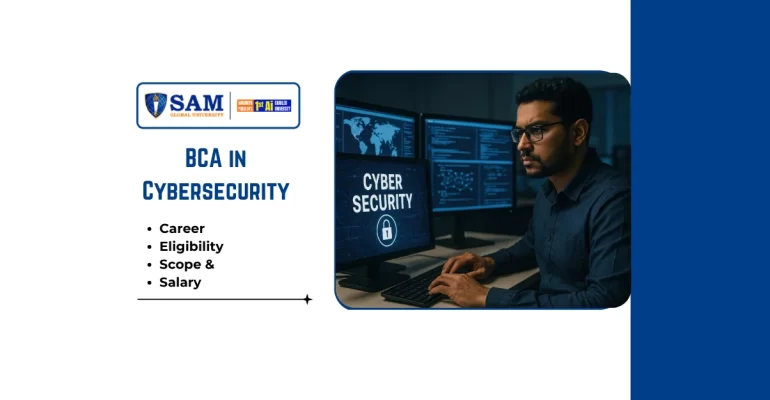
BCA in Cybersecurity: Subjects, Syllabus, Course Fees, Eligibility, Career & Salary (2026 Guide)
The digital world is expanding rapidly, and so are cyber threats. From banking apps and online shopping platforms to government websites and healthcare systems, almost every organization depends on secure digital infrastructure. As technology grows, protecting sensitive information has become more important than ever.
This is why BCA in Cybersecurity has become one of the most promising undergraduate courses after Class 12th. It combines computer applications with practical cybersecurity knowledge, preparing students to defend systems, networks, and data from cyber attacks.
If you're interested in ethical hacking, cyber defense, digital forensics, network security, or becoming a cybersecurity expert, this guide covers everything you need to know—from eligibility and syllabus to career opportunities, salary, and future scope.
What is BCA in Cybersecurity?
Bachelor of Computer Applications (BCA) in Cybersecurity is a 3-year undergraduate degree program designed to develop technical skills in software, networking, operating systems, ethical hacking, cloud security, digital forensics, cryptography, and cyber law.
Unlike a traditional BCA, this specialization focuses on protecting digital assets against cyber threats while providing a strong foundation in programming and computer applications.
Students learn through:
- Practical lab sessions
- Live cybersecurity tools
- Case studies
- Penetration testing exercises
- Security audits
- Industry projects
- Internship opportunities
The course is ideal for students who enjoy solving technical problems and want to build a career in information security.
Why Choose BCA in Cybersecurity?
Today, cyber attacks affect businesses of every size. Organizations need professionals who can identify vulnerabilities before hackers exploit them.
Some reasons why students choose this course include:
- Growing demand for cybersecurity professionals
- Excellent career opportunities in India and abroad
- Attractive salary packages
- High job security
- Opportunity to work with multinational companies
- Diverse career options
- Scope in government and private sectors
- Pathway to global cybersecurity certifications
BCA in Cybersecurity Course Highlights
| Particular | Details |
|---|---|
| Course Name | BCA in Cybersecurity |
| Duration | 3 Years (6 Semesters) |
| Course Level | Undergraduate |
| Eligibility | 10+2 from a recognized board |
| Admission | Merit-based or Entrance-based (varies by university) |
| Study Mode | Regular |
| Industry Exposure | Projects, Labs, Workshops & Internships |
BCA in Cybersecurity Eligibility
Students must fulfill the following eligibility criteria:
- Passed Class 12th from a recognized board
- Students from Science, Commerce, or Arts streams may apply (subject to university eligibility)
- Minimum qualifying marks as per university norms
- Basic computer knowledge is an added advantage
BCA in Cybersecurity Admission Process
Admission generally involves these steps:
Step 1
Fill out the online or offline application form.
Step 2
Upload required academic documents.
Step 3
Appear for an entrance exam (if applicable).
Step 4
Merit list or counseling.
Step 5
Document verification.
Step 6
Fee payment and admission confirmation.
BCA in Cybersecurity Subjects
The curriculum blends programming with advanced cybersecurity concepts.
Programming Subjects
- Programming in C
- C++
- Java Programming
- Python Programming
- Data Structures
- Database Management System
- Web Technologies
- Software Engineering
Networking Subjects
- Computer Networks
- Network Administration
- Network Security
- Wireless Security
- Cloud Networking
Cybersecurity Core Subjects
- Introduction to Cybersecurity
- Ethical Hacking
- Information Security
- Cryptography
- Cyber Law
- Digital Forensics
- Malware Analysis
- Incident Response
- Security Auditing
- Penetration Testing
- Identity and Access Management
- Risk Management
Practical Subjects
- Linux Administration
- Security Tools Lab
- Vulnerability Assessment Lab
- Cloud Security Lab
- Digital Forensics Lab
- Major Project
- Internship
Semester-wise BCA in Cybersecurity Syllabus
Semester 1
- Computer Fundamentals
- Programming in C
- Mathematics
- Digital Electronics
- Communication Skills
- Practical Lab
Semester 2
- Data Structures
- Operating Systems
- Computer Networks
- Database Management System
- Environmental Studies
- Lab
Semester 3
- Java Programming
- Python Programming
- Web Technologies
- Information Security
- Linux Administration
Semester 4
- Ethical Hacking
- Network Security
- Cryptography
- Cyber Law
- Cloud Computing
Semester 5
- Digital Forensics
- Penetration Testing
- Security Audit
- Malware Analysis
- Incident Response
- Mini Project
Semester 6
- Advanced Cybersecurity
- Cloud Security
- Capstone Project
- Internship
- Viva
Skills You Will Learn
During the course, students develop:
- Programming
- Ethical Hacking
- Network Security
- Linux Administration
- Cloud Security
- Cyber Risk Assessment
- Penetration Testing
- Security Auditing
- Digital Investigation
- Incident Response
- Communication Skills
- Problem Solving
BCA in Cybersecurity Course Fees
Course fees vary depending on the university, infrastructure, faculty, and facilities.
| Institute Type | Approximate Annual Fees |
|---|---|
| Government Colleges | ₹20,000 – ₹70,000 |
| Private Colleges | ₹50,000 – ₹2,00,000 |
Many institutions also offer:
- Scholarships
- Merit-based fee concessions
- Installment payment options
- Education loan assistance
Career Opportunities After BCA in Cybersecurity
Graduates can work across multiple industries such as IT, Banking, Healthcare, Telecom, E-commerce, Government, Defense, and Consulting.
Popular job roles include:
Cybersecurity Analyst
Monitors networks, identifies threats, and responds to security incidents.
Information Security Analyst
Develops security policies and safeguards organizational data.
Ethical Hacker
Performs authorized penetration testing to identify vulnerabilities.
Security Consultant
Advises organizations on strengthening cybersecurity frameworks.
Penetration Tester
Tests applications and networks to uncover security flaws.
SOC Analyst
Works in Security Operations Centers to monitor cyber threats in real time.
Network Security Engineer
Designs and maintains secure network infrastructure.
Incident Response Analyst
Investigates and manages cybersecurity incidents.
Digital Forensics Analyst
Examines digital evidence to investigate cybercrimes.
Cloud Security Associate
Protects cloud environments and ensures secure deployments.
Top Recruiters
Leading organizations that hire cybersecurity graduates include:
- IBM
- Accenture
- Infosys
- TCS
- Wipro
- HCLTech
- Tech Mahindra
- Deloitte
- Capgemini
- Cognizant
- EY
- PwC
- KPMG
- Cisco
- Palo Alto Networks
BCA in Cybersecurity Salary in India
Salary depends on skills, certifications, location, and experience.
| Experience | Average Annual Salary |
|---|---|
| Fresher | ₹3 LPA – ₹6 LPA |
| 2–5 Years | ₹6 LPA – ₹12 LPA |
| 5–10 Years | ₹12 LPA – ₹20 LPA+ |
| Senior Cybersecurity Experts | ₹20 LPA – ₹40 LPA+ |
Higher Study Options After BCA in Cybersecurity
Students can pursue:
- MCA
- M.Sc Cybersecurity
- MBA (IT)
- PG Diploma in Cybersecurity
- M.Tech (for eligible candidates)
Professional certifications include:
- CEH
- CompTIA Security+
- CompTIA CySA+
- CHFI
- CISSP
- CISM
- CCNA Security
- Google Cybersecurity Professional Certificate
Future Scope of Cybersecurity
Cybersecurity is expected to remain one of the fastest-growing technology domains. Increasing digital transformation, cloud adoption, AI-driven systems, IoT devices, and stricter data privacy regulations continue to create demand for skilled professionals.
Graduates can explore opportunities in:
- IT Companies
- Banks
- Government Departments
- Defence Organizations
- Healthcare
- E-commerce
- FinTech
- Cybercrime Investigation
- Consulting Firms
- Startups
- International Companies
Is BCA in Cybersecurity a Good Career Choice?
Yes. If you enjoy technology, logical thinking, and solving security challenges, BCA in Cybersecurity offers strong career prospects. The course provides a balance of computer application fundamentals and specialized cybersecurity skills, making graduates valuable across multiple industries.
To stand out, students should actively participate in internships, cybersecurity competitions, and hands-on projects while earning industry-recognized certifications.
Frequently Asked Questions
Is BCA in Cybersecurity better than a regular BCA?
A BCA in Cybersecurity is ideal for students who want to specialize in information security, ethical hacking, and cyber defense. A regular BCA offers a broader computer applications curriculum, while the specialized program focuses more on cybersecurity careers.
Can Commerce or Arts students apply for BCA in Cybersecurity?
Yes, many universities allow students from Science, Commerce, and Arts backgrounds to apply, provided they meet the institution's eligibility requirements.
Does BCA in Cybersecurity include ethical hacking?
Yes. Ethical hacking is a key subject in most BCA in Cybersecurity programs, where students learn penetration testing, vulnerability assessment, and responsible security practices.
What is the average salary after BCA in Cybersecurity?
Fresh graduates typically earn between ₹3 LPA and ₹6 LPA. With experience, certifications, and specialized skills, professionals can earn significantly higher salaries.
Which programming languages are taught in BCA in Cybersecurity?
Students commonly learn C, C++, Java, Python, SQL, and scripting languages used in security automation and application development.
Is mathematics compulsory for BCA in Cybersecurity?
This depends on the university's admission policy. Many institutions accept students without Mathematics at the 10+2 level, while others may require it or offer bridge courses.
What certifications should I pursue after BCA in Cybersecurity?
Popular certifications include CompTIA Security+, CEH, CySA+, CHFI, CISSP (after gaining experience), and cloud security certifications from leading providers.
Can I get a government job after BCA in Cybersecurity?
Yes. Graduates may apply for technical roles in government departments, public sector organizations, cybersecurity agencies, law enforcement, and defense, subject to the recruitment eligibility criteria.
Conclusion
BCA in Cybersecurity is an excellent choice for students looking to build a future in one of the most dynamic and in-demand technology fields. With a curriculum that combines programming, networking, and advanced security concepts, the course equips graduates with the practical skills required to protect digital systems in today's connected world.
As cyber threats continue to evolve, organizations are investing heavily in skilled cybersecurity professionals. By combining classroom learning with internships, projects, and globally recognized certifications, students can unlock rewarding career opportunities and long-term professional growth.
Get Free Career Counselling
Related Posts




Search
Categories
- 10th 12th Result (69)
- 12th Boards Preparation Series (88)
- After 12th Careers (152)
- Agriculture (13)
- AI (17)
- B. Tech CS (AI) (5)
- B. Tech CS (DS) (5)
- B.J.M.C (2)
- B.Sc Forensic Science (1)
- Bachelor of Engineering (12)
- BAMS (17)
- BBA (3)
- BCA (8)
- BSc Nursing (15)
- Computer Science Engineering (7)
- Education (1)
- Genius 2025 (7)
- Genius 2026 (13)
- Genius 2027 (5)
- Industry (1)
- Jobs (33)
- LAW (2)
- LLB (2)
- Machine Learning (3)
- Management (3)
- Master of Public Health (MPH) (1)
- MBA (6)
- MCA (Cyber Security) (2)
- Msc Agriculture (1)
- Nursing (24)
- Paramedical (14)
- Pharmacy (14)
- Phd (1)
- Uncategorized (1)
Popular Tags
Popular tags